Impact Sockets or Chrome Sockets — and Where the Torque Wrench Belongs
How to tell an impact socket from a chrome one, which drive size to buy first, and the habits that keep a torque wrench honest.
Two sockets can look identical in the tray and behave in opposite ways on a power tool. A torque wrench is the tool people expect to be exact, and the one most often used as a lever. Here is how to tell the two socket ranges apart, and what keeps a torque wrench trustworthy.
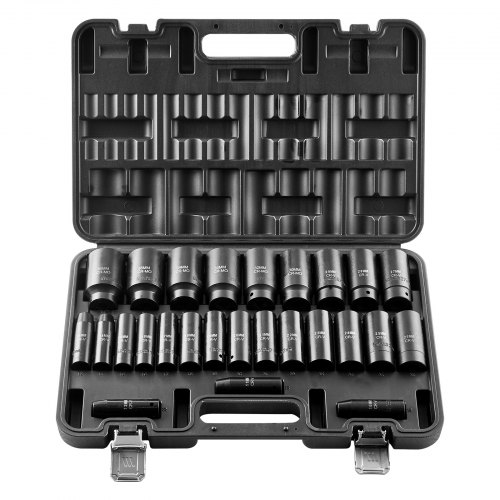
An impact socket is not a chrome socket with a black finish
Two things change between the ranges, and neither is cosmetic:
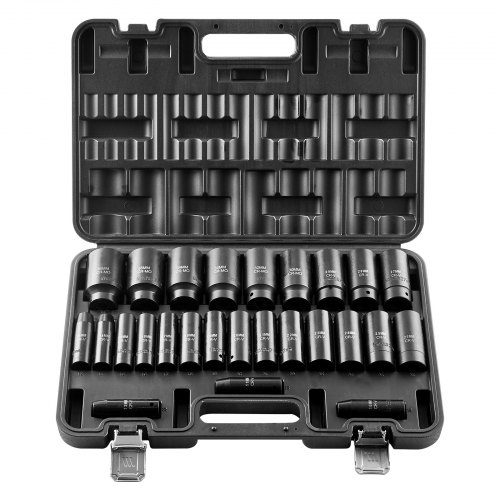
- Steel and wall thickness — ours are forged from CR-V steel, black-oxide finished rather than chrome plated, with a thicker wall at the drive end where a power tool loads the socket. Nothing can chip off, and the socket deforms under overload instead of shattering.
- Retention — impact sockets use a pin-and-ring groove that grips the anvil while the tool runs; a chrome socket relies on a ball detent, fine for a ratchet, not for an impact wrench.
Put a chrome socket on an impact wrench and the failure is sudden: it cracks and a fragment leaves the working area. That is an accident, not wear.
The drive size tells you the job, not the price bracket
Drive size matches the torque you need to the space available:
- 1/4 in drive — interior trim and small fasteners, 4–14 mm.
- 3/8 in drive — engine ancillaries and brake calipers, 6–24 mm.
- 1/2 in drive — wheel bolts, suspension and anything seized, 10–32 mm. Buy this one first.
A 1/4 in set is not a cheap version of a 1/2 in set; they do different jobs. A large set in the wrong drive size is how sockets end up never leaving the case. For hubs, 3/4 in drive runs 19–50 mm.
Where the torque wrench belongs
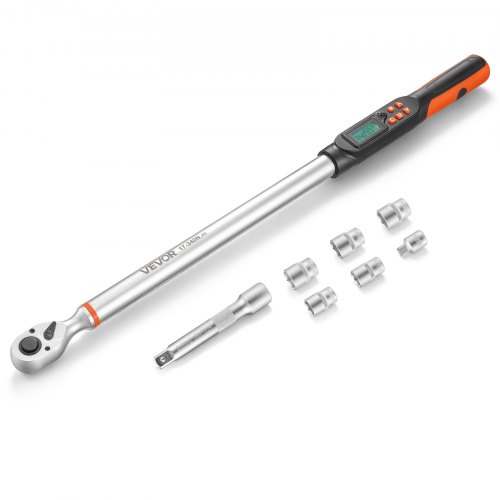
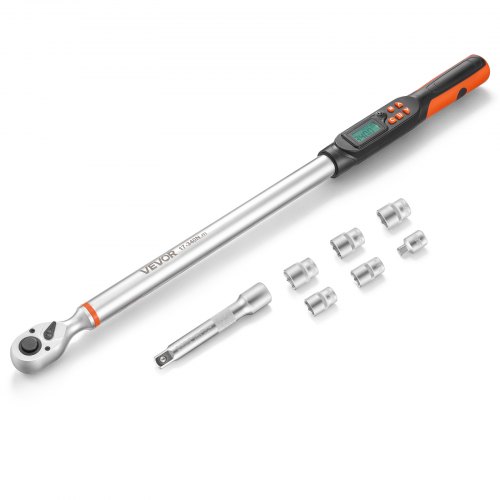
A torque wrench is a measuring instrument, not a lever: it tightens to a figure and should never break a seized fastener loose. Three habits keep its readings honest.
- Use the middle of the range — a 20–210 Nm wrench is most reliable mid-band; for a 45 Nm brake caliper the 20–110 Nm model is the better tool.
- Rewind it before storage — left wound up, the spring inside takes a set and the scale reads low with nothing to warn you.
- Mind the adaptor — a rigid, hardened adaptor passes the setting through unchanged; a springy one flexes, and the wrench reads that as torque.
The socket sets and the torque wrenches are listed by drive size and range, so the two families can be compared on the catalogue pages instead of from a photo. Packed weight is worth checking: the 17-piece impact set packs to 2.8 kg, a 40-piece chrome set to 3.3 kg.
Every order ships from our own stock to the UK and the EU on DDP terms — duty, clearance and door delivery are included, so there is nothing to pay on arrival; see our delivery note. Most of the catalogue travels by sea at 45–60 days door to door, because air freight on a socket set would cost more than the sockets inside it.